Species Profile
African Dwarf Frog
Hymenochirus boettgeri
Also known as: ADF, Dwarf Frog, Dwarf Underwater Frog
Oddballspeaceful
Adult size
1.5″
Minimum tank
10 gal
Temperature
72–82°F
pH
6.5–7.8
Schooling
Group of 2+
Water level
bottom
Diet
Sinking pellets, frozen bloodworms, brine shrimp, blackworms. Bad eyesight — drop food directly in front of them and turn off any current that scatters it.
Notes
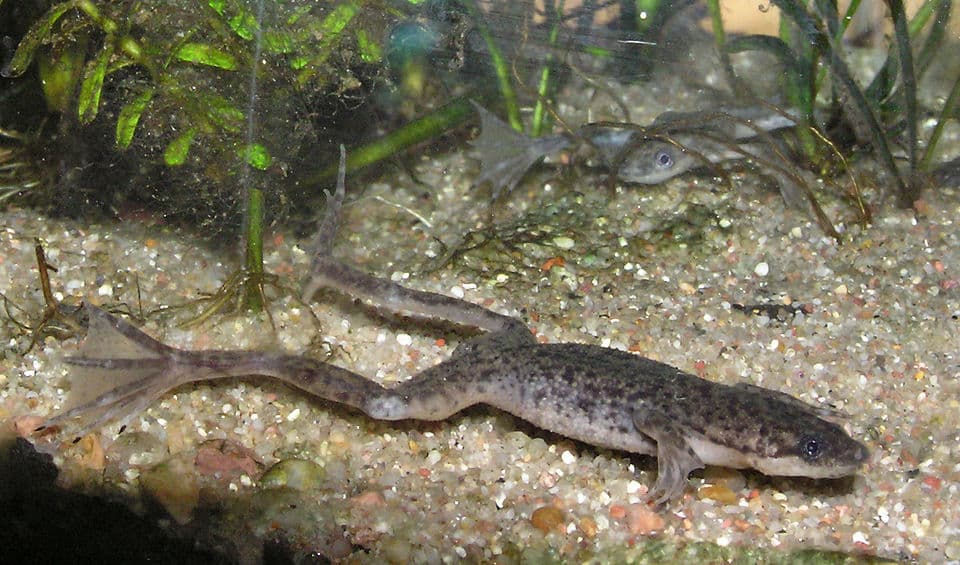
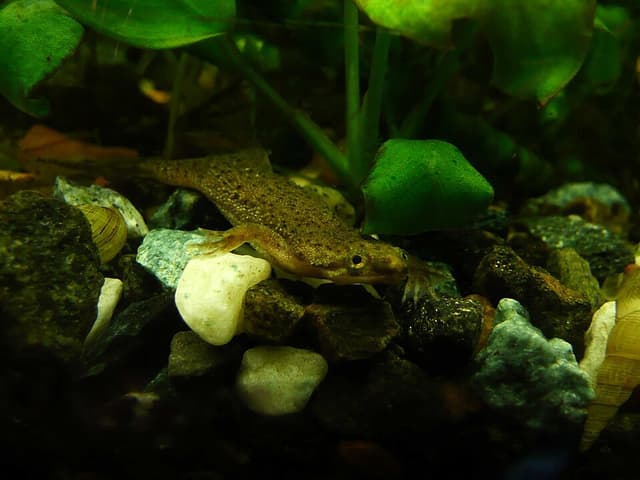
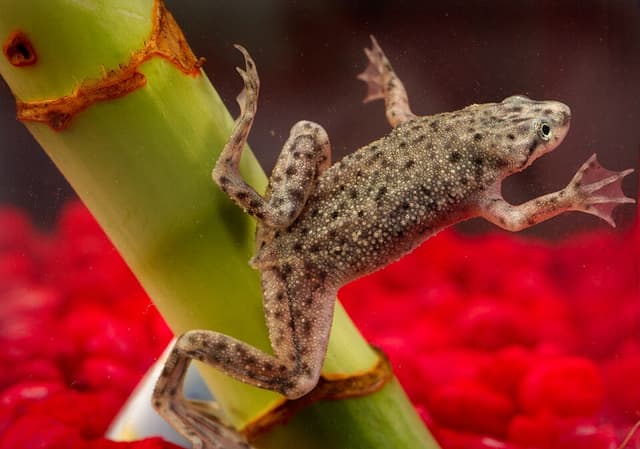
Fully aquatic dwarf frog — no land or basking required. Surfaces every few minutes to breathe so the tank needs an open lid area, not a sealed top. Slow eaters with poor vision: fast or aggressive tankmates will out-compete them for food. Avoid sharp gravel — soft sand or smooth stones only, their skin is delicate. Often sold mis-labeled as African Clawed Frogs, which grow to 5” and eat everything else in the tank; the ADF has webbed front feet and stays small.
Tank Setup
10 gallon minimum for a pair, 20 long for a group of 4–6. Sand or smooth-stone substrate (sharp gravel scrapes skin). Gentle filtration — ADFs hate strong current and may not surface to breathe if pushed around. Lid the tank with a tight-fitting cover but leave a 1” air gap above the water for breathing; without the gap they exhaust themselves swimming up against the underside.
Behavior
Sluggish daytime, more active at dusk. Often play dead at the bottom — alarming the first time but normal. Surface in fast vertical bursts to breathe air, then sink back down. Social with each other; a group will pile up together to sleep.
Breeding
Possible in a species-only tank. Males clasp females during amplexus and the pair releases eggs at the surface. Adults eat their own eggs and tadpoles — separate the eggs into a rearing tank to raise fry. Feed tadpoles infusoria and crushed flake.
Health
Susceptible to fungal infections on the skin from rough handling or sharp substrate. Watch for cloudy eyes (water quality) and bloating (overfeeding — they eat anything until they explode). Sensitive to copper and most fish-disease meds; quarantine sick frogs separately rather than dosing the main tank.
Frequently Asked
Can African Dwarf Frogs live with bettas?
Usually yes, with caveats. Bettas often ignore ADFs but some are bullies. The bigger problem is feeding: bettas eat everything floating, ADFs need food on the bottom and are too slow to compete. Drop pellets directly in front of the frogs and watch the first few feedings.
Do they need land area?
No — ADFs are fully aquatic. They surface to breathe air every few minutes but spend their lives underwater. Don't confuse them with the African Clawed Frog (Xenopus), which is a different (and much larger, fish-eating) species.
How can I tell ADFs from African Clawed Frogs at the store?
ADFs have webbed front feet and stay under 2”. Clawed Frogs have separated, claw-like front toes (no webbing) and grow to 4–5”. Pet stores frequently mis-label them; if the frog has separate front toes, it's not an ADF and it will eat your fish.
Photo: Mwatro / Wikimedia Commons · Source · CC-BY-SA-3.0